Winter is now upon us and whilst it is one of the quietest times of the year in the garden there are still jobs that can be done.
November is a perfect month to prepare your outdoor areas for the harsh weather ahead and get a head start on next year’s gardening season. If you have a pond or water feature it is a good idea to net it to stop excess leaves falling in and creating problems.
November is normally the month during which you will do the final mow of your lawn and it is important to remove any leaves that have fallen so that they do not decompose and encourage the growth of mould. Any outdoor structures should be checked to make sure they are watertight and will withstand the harsh winter weather and outdoor furniture should be stored or covered up to avoid any damage.
Contrary to most people’s thinking, the planting season actually starts in October and ends in April.
This means that through the months of dormancy you can plant bare root and root balled as well as containerised plants. Last month I mentioned adding new paving to existing paving and this concept can also be applied to planting. A popular way of changing the look of your garden without outlaying as much money, is to incorporate existing plants with new planting schemes.
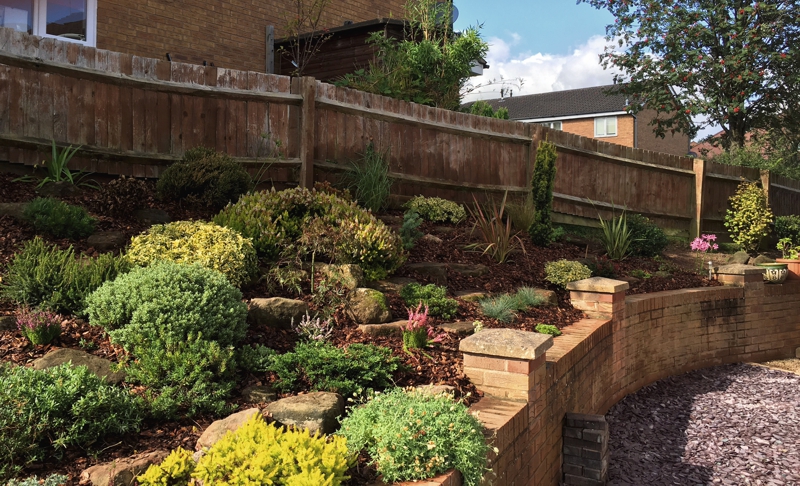
One of my recent projects was on a sloping rear garden which involved re-setting the existing rockery stones with new ones.
Although some of the stones were not ideal, sometimes you have to do the best with what you have and utilising various plants will provide you with a good basis to create an interesting bed or rockery.
The general rule of thumb with any bed is to plant in odd numbers, 3, 5 or 7 plants in a group, the most common being 3.
Try to plant one tall plant, an ornamental grass for example, a medium sized bushy plant and a low, wide spreading shrub thus providing a difference in height and a more interesting feature.
The use of so-called architectural plants is also important as they add interesting structure and heights, for example the twisting upward growing branches of Corylus avellana Contorta (contorted hazel).
Please see above, a picture of a recent project in Newport illustrating this strategy.
If you would like any advice or a free no obligation quote, please call me, Stephen
on 07989 169525 or 08456 832500. •