Most readers of this page will probably already be aware of the importance of collagen in maintaining the appearance of one’s complexion – it is such an integral part of skin conditioning, being the subject of considerable research and discussion.
There are far too many solutions to collagen generation to mention them all in this article so I have selected a few which are relevant and I have found, over time, work effectively in practice. In summary, collagen is a protein which exists within the connective tissue in the skin which helps to promote firmness, suppleness and renewal of skin cells situated within the dermis – the lower of our two skin layers. As we age the process of collagen production decreases – this happens to everybody to a greater or lesser degree – resulting in loss of muscle tone, sagging skin and formation of lines and wrinkles.
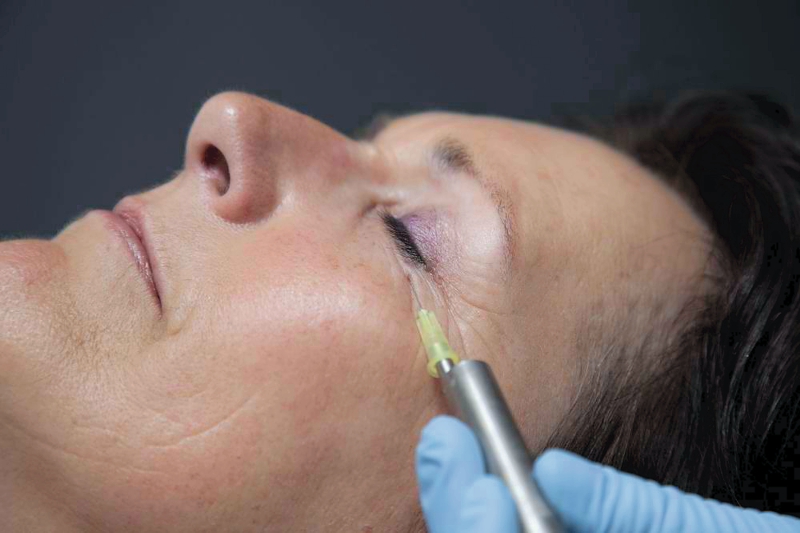
The challenge for the skin therapist is to reverse this process which actually can be achieved by giving Mother Nature a helping hand. This is possible by the application of a mildly invasive procedure working below the epidermis. Penetrating the epidermis with a fine probe(s) enables damage to be caused to the cells within the dermis – the skin then responds and begins to heal producing new collagen and elastin which plump out the skin. This concept may sound a little daunting but it is now common practice within the aesthetics industry with few, if any, after-effects. The effect is to tighten the muscle tissue and reduce lines and wrinkles. Working with this principle there are now three techniques depending on the areas of the face/body requiring treatment – these are Bio Skin Jetting (BSJ) for individual lines and wrinkles such as frown lines and crow’s feet, dermal rolling for the cheeks and décolletage and the dermal stamp for areas such as around the eyes and nasolabial folds which can be difficult to access.
BSJ is sometimes used in conjunction with skin smoothing – essentially this is a single point probe which is introduced into the dermis following the application of topical anaesthetic cream to minimise any discomfort. The procedure requires certain movements within the dermis to activate the new collagen. Several treatments may be required to obtain best results. Dermal rolling is now recognised as the generic term for this procedure whereby a hand held roller is used. The roller is approximately 4-5 inches long and 1-1½ inches in diameter and contains around 200 fine needles protruding from the surface – similar treatment multiples apply. The dermal stamp involves the same principal feature of very fine protruding needles but is of a much smaller construction enabling awkward areas to be accessed.
If you would like any further information regarding collagen replacement or any other aspect of skin care you can contact me, Anne on 01952 814200 or via email info@elitebeautycare.co.uk •