“Where are your microwaves?” is the most common question we get asked in Tylers (other than “Have you any fans?” during the very hot summer we have had).
These days microwave ovens are an essential appliance in any kitchen, mostly because they can defrost and cook your food quickly. They heat your food because the microwave radiation that they produce is absorbed by water and fat molecules causing the molecules to rotate and then collide with other molecules. Although microwaves are very useful for defrosting food, it does take longer to heat ice than liquid water because the movement of the water molecules in ice is more restricted. The liquid water and fat parts of your food will heat up the most, causing uneven heating throughout your food, which is why your cooking instructions often require a standing time.
Your traditional turntable microwave emits the microwaves from a fixed antenna (part of the magnetron) on the side of the microwave just behind the control panel. The microwaves then bounce around the cavity but can cause hotspots where the microwaves interfere. This is similar to the radio dead spots you experience when you drive around a city – tall buildings reflect the radio waves causing interference. The turntable in your microwave keeps the food moving through these hotspots to try to heat the food more evenly.
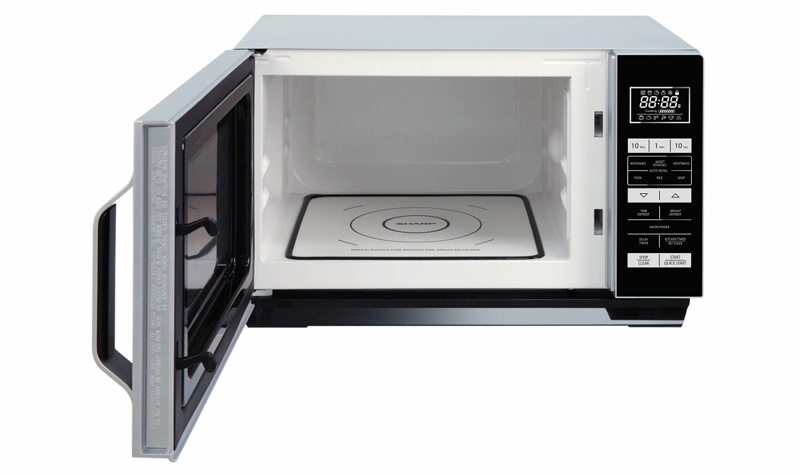
A flatbed microwave has the antenna underneath, and it is the antenna that rotates, not your food. The microwaves bounce around the cavity but are constantly being emitted from a different position. You may need to raise your food up in a flatbed microwave by using a glass plate or silicon trivet. The benefits of flatbed microwaves are a larger volume can be heated, food may be heated more evenly and they are easier to clean. There is no chance that the turntable is going to get stuck, or that it will break. You may need to adjust your cooking times. Flatbed microwaves are also ideal if you have square plates.
Microwaves don’t often brown the food (as they don’t often reach the temperatures of 140-165ºC to do this by the Maillard reaction). If you want the speed of microwaving and the flavour of browning then a combination microwave will suit you. These combine a standard microwave with a convection oven to heat the cavity at the same time as blasting it with microwaves. They also have a grill, making them truly multi-purpose.
To answer the original question: Our selection of microwaves, including flatbed and combination microwaves, is conveniently positioned next to the counter. •