Every inch of the road was packed with students and parents looking for a parking space. Of all days I had taken a wrong turn and ended up in the school run chaos by Newport Girls’ High School and Moorfield Primary. As I tried desperately to continue my journey, I was so relieved to be driving the compact Hyundai i10. Judging by the lines of small cars parked bumper to bumper, students also find it a huge benefit to drive a small car when you have to find parking in a tiny gap.
The third generation i10 is a brand new car from the ground up and in comparison to other cars in the A segment, has a full five-seat configuration when many only offer four seats. The city car which went on sale on 18 January, has a lowered roof by 20mm, a wider body by 20mm and a longer wheelbase by 40mm.
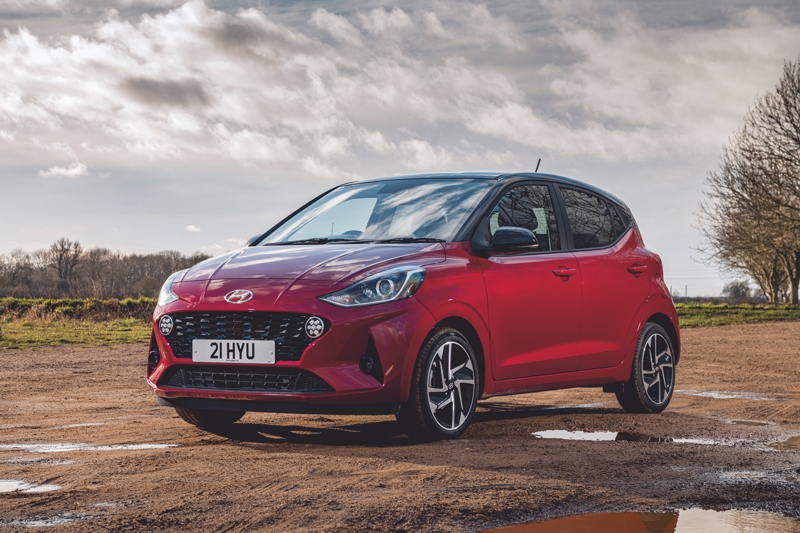
Exterior looks benefit from newly designed optional 16-inch alloy wheels which are very distinctive. The halogen headlamps are dotted with small lamps which from a design point of view are gorgeous.
My road test car was a bit of a head-turner, with ice blue paintwork and body-coloured door handles and an optional Phantom Black roof which merged with the privacy glass.
When I got over admiring the design and got behind the wheel, I was startled to see an SOS button centre top windscreen. A feature I’ve only ever found on much larger premium cars. I also didn’t expect a small car to have the technology which alerts the driver that the car in front has moved forward. Hyundai is repositioning this model with high levels of design and specification. The standard equipment includes DAB radio with 3.8″ display, Bluetooth, air conditioning, electric windows, leather steering wheel and gear lever, electric mirror adjustment, and cruise control.
The top of the range Premium model adds LED daytime running lamps, front fog lamps, heated front seats and steering wheel. I really liked the honeycomb design to the dashboard, door, and gear lever surround trims.
The i10 has the highest levels of safety equipment within the A segment and includes high beam assist, forward collision warning, and autonomous emergency braking.
The SOS eCall system will automatically dial emergency services in the event of a serious accident. Other safety equipment includes Lane Keep Assist and Lane Departure Warning.
An option on the Premium model, which I think is well worth the £1,000 is the Tech Pack that includes a wireless charging pad for compatible handheld devices and adds an 8″ touchscreen navigation with Bluelink® telematics, giving owners the ability to locate the vehicle via GPS. Useful when, as a small car, it can easily get lost while parked on a car boot or exhibition field! New owners can send navigation instructions via smartphone and remotely lock the vehicle. The intelligent speed limit warning provides the driver with a visual indication of the current speed limit.
I’m struggling to think of a reason why I wouldn’t buy this car. CO2 emissions start at 101g/km. The 1.2-litre petrol engine reaches 62mph in 12.6 seconds and a top speed of 106mph. For the amount of urban driving I made this week, the i10 was certainly nippy enough to get me sharply onto a roundabout and in front of the pack when leaving traffic lights.
The 5-speed manual gearbox slicks easily from gear to gear and there is a new 5-speed automated manual transmission.
The Hyundai i10 is just the car to drive around a town or city, especially when trying to find a parking space.
You can follow Sue Cooke on Twitter @cookecars and there are more of her reviews on novamagazine.co.uk •
Facts at a Glance
Model: Hyundai i10 Premium
Price: £ 14,995 otr
Engine: 1.2 litre MPi 84 PS 5 speed manual
Performance: 0-62mph in 12.6 seconds and on to a top speed of 106 mph
CO2 emissions: 105g/km
Combined fuel consumption: 55.4mpg (WLTP)