I thought this month it might be valuable to share an insight into the major costs associated with running a care home or nursing home. I propose to talk about the facts around keeping care homes solvent and steer clear of the ever-emerging political situation.
The ‘cost of living crisis’ is affecting us all, with the soaring price of food, energy, fuel, mortgages etc. A care home faces many of the same financial pressures as your home, after all it is ostensibly a very BIG house, but one that is staffed and has legislation to comply with like Fire and CQC, and of course it must be kept warm (around 22°C).
I have heard many conversations over my 18 years in care, about how ‘expensive’ care is, but of course many of the running costs are simply hidden from public view in the company accounts. This month I thought it would useful to some people to share the sort of financial challenges facing care establishments, in the hope that it goes some way to explaining why fees for residential and nursing care often exceed £1,000 per week.
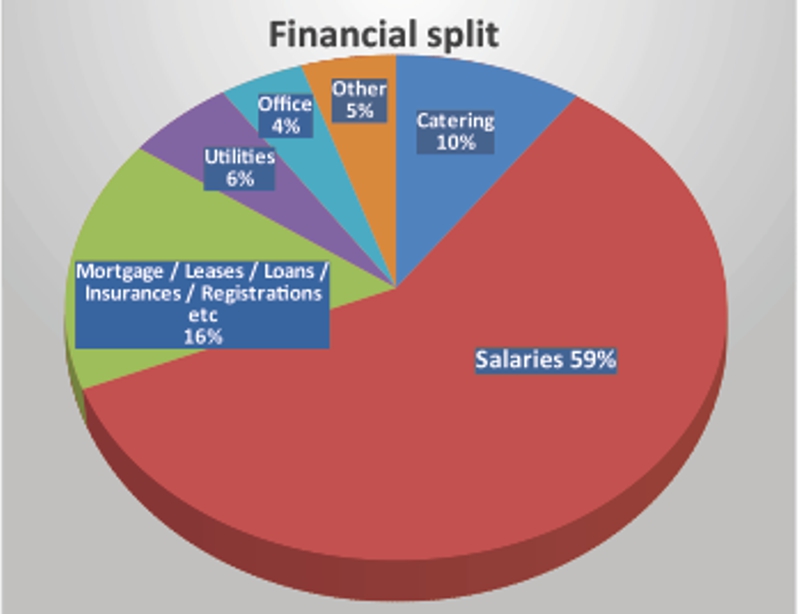
The chart below shows in percentage terms the major financial splits for Sambrook House, this will vary slightly from home to home.
I’ve left out the thin line called PROFIT, but every company has to make a profit as it enables growth and investment as well as maintaining solvency. It is clear from the chart that Salaries are by far the biggest cost to a care home – the rest, it could be argued, is similar to household splits.
From 1 April all homes will see an increase in staffing costs, fuel, and supplies, so the next area looks at what are the projected increases, and the overall impact they will have on running costs.
National Living Wage is a legal line set in the sand that no employer is allowed to go under. Since 2016 it will have risen by 31% from £7.20/hr and from this year’s £9.50/hr to £10.42/hr from April. As with many industries, this shapes the care sector’s wage structures and seniority differentials. This year’s increase is 9.7%.
Food has risen by around 6% so far this year.
Mortgages have risen by about 4% and insurances have doubled, though registration fees are largely the same, giving around a 6% rise in real terms.
Utilities are a huge issue for all of us. My understanding is that the Government support is being withdrawn in April. Like most companies, we had a three-year fixed-rate electricity contract and sadly ours expired in December. Our increase to the newly negotiated electricity contract is an increase of 116%, and oil for heating has almost doubled with around an 85% increase.
Office costs are fairly stable at about a 4% increase (though the cost of paper has soared).
The section ‘other’ is looking like around a 5% increase.
Income comes from Local Authority Funded clients and Private clients (most homes will have a mixture of the two). In our case, the only income stream is from our 28 residential care beds.
The overall increase in costs for Sambrook House from April is projected to be 13.5% (the doubling of fuel costs having a major impact), which means for every £1,000 we spent this year to run the home, we need to find £1,135 next year just to stand still.
I hope that this article helps with the understanding of where fees are spent and why care is an increasingly expensive, though utterly essential, service. Many managers like me will be battling with the figures in preparation for April, and to be frank, it is the largest cost increase I have seen; scary!
by Neil Robson, Director
Sambrook House Residential Care Home