Going digital – the journey begins!
 nova
1 February 2024
Today I thought I would share with you a real-life project as we embark on the long and difficult journey of ‘going digital’.
Like many care homes around the country, we have, for years, operated a paper-based care planning system. The care plan is the definitive document that contains all the information about one individual, from medical to contacts, from likes and dislikes to activities, as well as the ‘daily report’ which is a document that charts all the daily choices, visits, food, mood, activities etc.
Like many homes, we have ‘resisted’ the move to computerising the care planning and operational system for a number of reasons:
Computers crash – paperwork doesn’t
Computers require a new level of skill – paperwork requires the ability to read and write
Paper-based systems give us the control to add/develop with new forms as legislation and ideas change – with computer systems you are reliant on the software company
By its very nature a care plan is a huge, complex, living document which means that a computerised system will be equally large and complex
So why go digital?
One answer is ‘analyses’. Computers are very good at collating large amounts of data and producing valuable information, reports, graphs, and trends, all at the touch of a button.
Another answer is ‘management control’. From an overview of the home, the Manager can put on to the system instructions for the team (e.g. check every ½ hour overnight) and the system will alert the staff when these visits are due. It also gives an overview of the home’s operation as it isn’t restricted to care planning, but everything to do with the home that the clients live in, for example, cleaning regimes, maintenance, visitors, activities, menus, timesheets linking to payroll, medication. And in the future, it will be able to link with doctors’ notes, hospital admission and discharge notes, the lists are ever-growing.
But none of this happens overnight, and the transition (a journey which we started in December) is a long one. I cannot overemphasise how steep the learning curve is – for everyone!
The Government is very keen to encourage homes to transition to computer-based operation because bodies like the CQC can monitor the home’s performance remotely and in real-time. They have offered grant incentives to homes to take the plunge which (in our case) pays for about 1/3rd of the implementation costs.
Our first difficulty was choosing which product for us (this is not an advert). We reviewed the preferred supplier lists, visited several suppliers at an NEC exhibition, then went to a couple of homes that had already installed systems and eventually chose one.
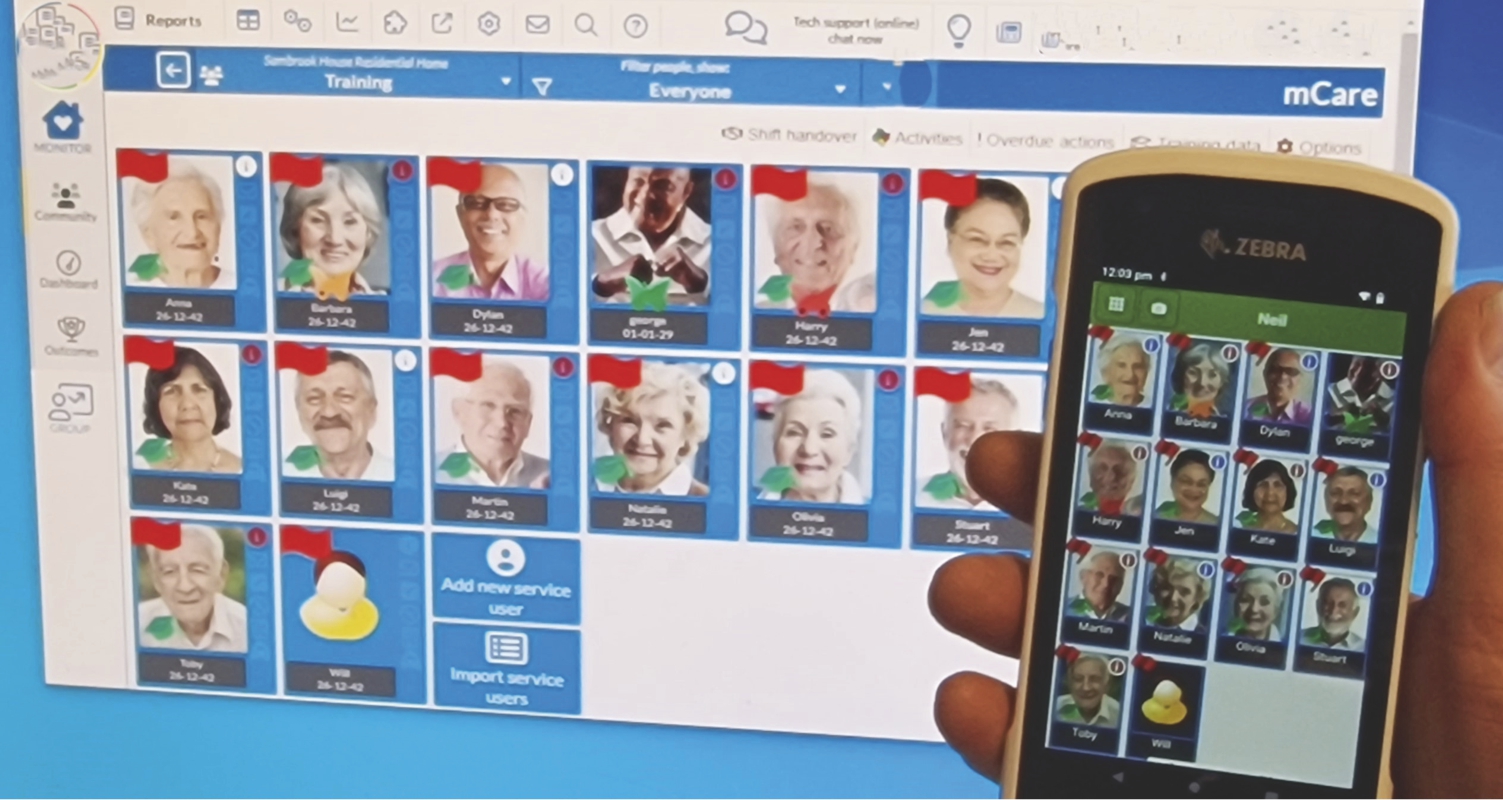
Our team of carers, cleaners, chefs, and maintenance will each have a handheld device that they log into for their shift. From there the whole process of entering information is largely icon based and very intuitive, with the ability to expand with written text or spoken word, as the device will convert the voice into text – so you don’t need to be a typist!
These devices link up in real-time to the cloud-based system which is accessed by Seniors and Management on a PC and it will produce reports, give notifications, create documents like hospital transfer notes and hand over notes.
I am guessing that we will begin to be proficient in around six months – in the meantime, we are running the old written system in parallel.
It is a time of great excitement, learning, and trepidation – I will write an update in about six months’ time! Please wish us (and all other homes on the same journey) luck.
NOTE: the enclosed image shows the training screen with fictitious people
by Neil Robson, Director
Sambrook House Residential Care Home