Choosing a bed that minimises partner disturbance
 nova
25 January 2026

At Newport Beds, we are familiar with the term ‘sleep divorce’! But we know that choosing a bed that minimises partner disturbance is often all it takes to avoid it. Read our tips below to find out more!
Sharing a bed should be comforting and not disruptive. Yet for many couples, sleep is regularly interrupted by fidgeting, tossing and turning, different schedules, or one partner getting up during the night or leaving early for work. Over time, poor-quality sleep can affect mood, health, and even relationships in the sleep department. And therefore…sleep divorce! At Newport Beds, we often speak to couples who are surprised by just how much their bed choice affects their shared sleep.
The good news is that choosing the right mattress and bed can significantly reduce partner disturbance…and hopefully sleep divorce!…by helping both sleepers to sleep and rest more soundly. Understanding what causes sleep disruption and what to look for when buying a bed can turn shared sleep from a nightly challenge into a genuine source of comfort and relaxation.
Why partner disturbance happens
Partner disturbance usually comes down to three main factors: movement transfer, comfort differences, and bed size. When one person moves and the mattress shifts beneath the other, sleep can be interrupted without either partner realising it. Differences in body weight, sleeping position, or tension (firmness) of the mattress preference can make the issue even more noticeable.
A mattress designed to minimise disturbance works by absorbing motion, supporting each sleeper individually and providing enough space for both partners to move comfortably. This combination is key to uninterrupted rest.
Look for excellent motion isolation
Motion isolation refers to how well a mattress absorbs movement rather than transferring it across the surface. For couples, this is one of the most important features to consider.
Memory foam mattresses are well known for excellent motion absorption, as the material contours closely to the body and dampens movement.
Hybrid mattresses, combining foam layers with pocket springs, can also perform extremely well – particularly when the springs are individually wrapped rather than connected.
Pocket spring mattresses deserve special mention. Each spring moves independently, responding only to pressure placed directly on it. This reduces movement transfer across the mattress while providing targeted support, making pocket springs an excellent option for couples who want both responsiveness and stability.
Note that traditional open-coil spring mattresses tend to transfer more motion and may be less suitable for light sleepers or restless partners.
In the Newport Beds showroom, we always encourage couples to test these in person, together. A simple movement test, such as one partner changing position while the other lies still, can quickly reveal how well a mattress controls motion and if it is suitable for each sleeper.
Choose the right level of support
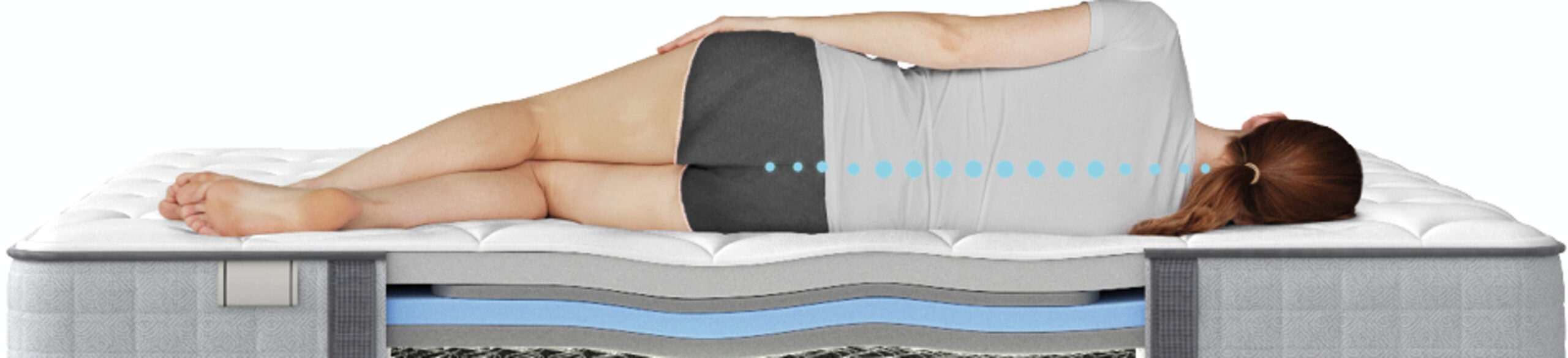
Support plays a major role in reducing sleep disturbance. A mattress that lacks proper support can cause sleepers to sink unevenly or shift frequently in search of comfort, increasing movement throughout the night.
Look for a mattress that offers individualised support, adapting independently to each person’s weight and sleeping position. Zoned support systems, where different areas of the mattress provide varying levels of firmness, help maintain correct spinal alignment while reducing unnecessary motion. This is especially helpful for couples with a noticeable weight or height difference. The Sealy Posturepedic range of mattresses offers this type of support, and Sealy works with the International Orthopaedic Advisory Board, which they have done so for nearly two decades. The board is made up of Orthopaedic surgeons, biomechanical engineers, and medical scientists. Their product development is therefore informed by scientific research, and by working alongside this board, they receive expert advice on supportive sleep.
Consider different comfort needs
One of the most common challenges for couples is differing comfort preferences. One partner may prefer a firmer feel, while the other finds a softer surface more comfortable.
Modern mattress designs offer practical solutions, including:
Dual-comfort or split tension mattresses, with different firmness levels on each side
Layered or adjustable designs, which allow comfort changes without replacing the entire mattress
Zip and Link options allow two mattresses to be zipped together and can be two different tensions. This is a good option as the beds can also be separated and used as standalone singles in the future
These options are popular with couples who want a long-term solution without compromise. While they may involve a slightly higher initial investment, they often prevent the need for early replacement.
Don’t overlook bed size
Sometimes, the simplest way to reduce partner disturbance is to increase space. A bed that is too small makes every movement more noticeable, particularly for restless sleepers.
Upgrading from a double to a king-size or a king-size to a super-king bed can make a remarkable difference. Extra width allows each partner to move independently without affecting the other. For couples with different schedules or those who share their bed with pets or young children, bed size can be just as important as mattress type.
Invest in a stable bed frame and bases
The mattress is only part of the equation. A poorly constructed or lightweight bed frame can amplify movement, noise, and vibration.
High-quality frames made from solid wood or reinforced metal, with strong centre support and platform or sprung top divan bases, provide a stable foundation that allows the mattress to perform as intended. Here at Newport Beds, we offer bed and mattress combinations designed to work together, helping to minimise motion and extend the life of both.
Test before you buy
An informed bed purchase always includes proper testing. Spending at least 10–15 minutes lying down together in your usual sleeping positions, moving, turning, and getting in and out of the bed reveals how well the bed handles disturbance for each sleeper.
At Newport Beds, we believe the right bed is an investment in shared comfort and long-term wellbeing, one that pays dividends every single night that both sleepers love, and one that may just avoid a ‘sleep divorce’ in the end!
Carpet Loom and Newport Beds