Missing teeth. What are your options?
 nova
20 February 2026
There are many reasons for tooth loss. No matter what the reasons are, replacing your lost permanent tooth is important both for better function as well as appearance. Gone are the days when the only option people had was to wait for all their teeth to be gone and then get a full denture made. The options could either be removable dentures or fixed bridges, or implants.
When teeth are missing, it can affect the way the rest of your teeth bite together. Your remaining teeth may tilt and drift into the gaps and food can get trapped in the spaces, increasing your risk of tooth decay and gum disease. When many teeth are missing, your facial muscles can become saggy, affecting your speech and appearance.
We offer a number of treatment options to restore your smile and fill any gaps that you may find unsightly or that may be affecting function.
Partial dentures – A partial denture can be used to replace one or more missing teeth. A partial denture is a framework (plate) with a number of false teeth on it. There are different types of partial dentures, but they commonly include a metal and/or plastic plate with plastic or porcelain false teeth. Partial dentures often have metal or tooth colour clasps, where possible, these clasps are hidden so that they can’t be seen when you smile or talk.
Full dentures – Full (or complete) dentures are needed when you have no teeth left in your upper or lower jaw. They are usually made of a plastic plate with plastic teeth. Full upper dentures cover the roof of your mouth, a very thin layer of saliva between your palate and the denture creates suction which keeps it firmly in position. Your facial muscles and tongue also help to keep it in place. Full lower dentures are often more difficult to keep in place because the floor of your mouth moves a lot, and the ridge where your teeth used to be shrinks with age. However, good dentures should fit your mouth exactly so you shouldn’t need to use denture adhesive cream (fixative).
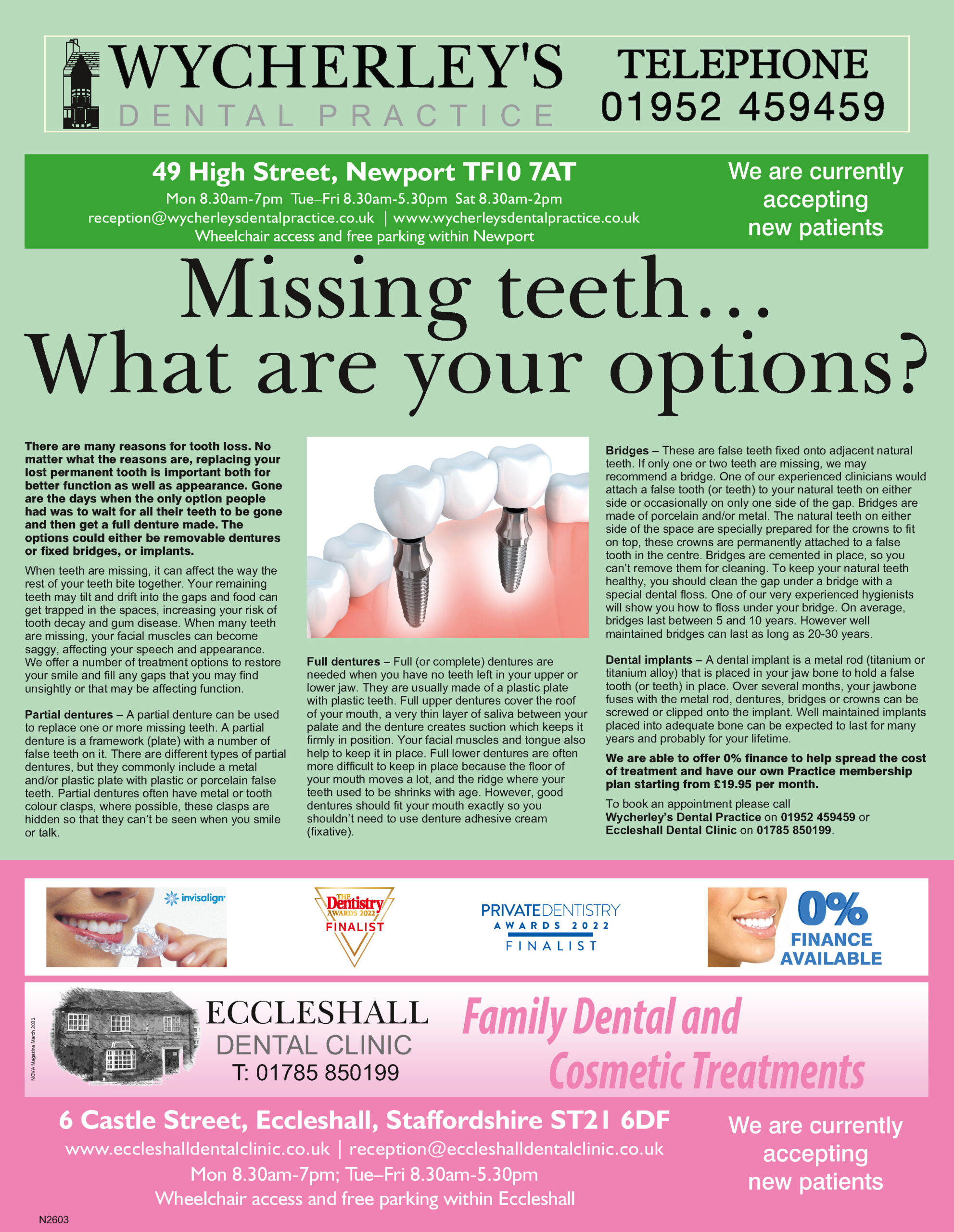
Bridges – These are false teeth fixed onto adjacent natural teeth. If only one or two teeth are missing, we may recommend a bridge. One of our experienced clinicians would attach a false tooth (or teeth) to your natural teeth on either side or occasionally on only one side of the gap. Bridges are made of porcelain and/or metal. The natural teeth on either side of the space are specially prepared for the crowns to fit on top, these crowns are permanently attached to a false tooth in the centre. Bridges are cemented in place, so you can’t remove them for cleaning. To keep your natural teeth healthy, you should clean the gap under a bridge with a special dental floss. One of our very experienced hygienists will show you how to floss under your bridge. On average, bridges last between 5 and 10 years. However well maintained bridges can last as long as 20-30 years.
Dental implants – A dental implant is a metal rod (titanium or titanium alloy) that is placed in your jaw bone to hold a false tooth (or teeth) in place. Over several months, your jawbone fuses with the metal rod, dentures, bridges or crowns can be screwed or clipped onto the implant. Well maintained implants placed into adequate bone can be expected to last for many years and probably for your lifetime.
We are able to offer 0% finance to help spread the cost of treatment and have our own Practice membership plan starting from £19.95 per month.
To book an appointment please call Wycherley’s Dental Practice on 01952 459459 or Eccleshall Dental Clinic on 01785 850199.