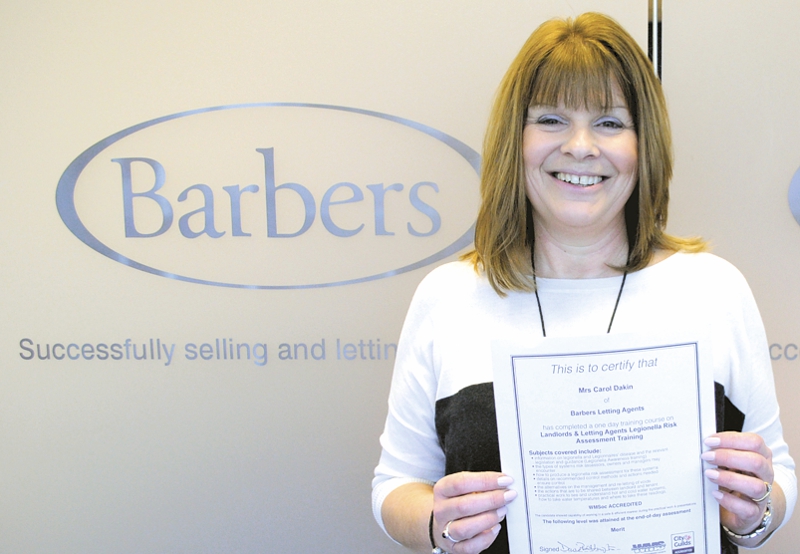
With all the speculation and concerns there have been recently about Legionella, Carol Dakin, Head of Property Management at Barbers along with one of our main contractors have undertaken the Water Management Society – Landlords and Letting Agents Legionella Risk Assessment Training that is City & Guilds accredited. This has enabled us to give a clear picture of the responsibility for landlords.
One of the tutors on the course had actually been involved in the rewording of the Health and Safety Executive Approved Code of Practice 2013 regarding the responsibility of legionella risk in a rented property. This made it so much clearer as to the requirements.
Legionella comes under L8 – Special Legal Status which requires the landlord or managing agent to act as the duty holder to risk assess the property for legionella – this includes: Identifying and Assessing the Risk, Managing the Risk, Prevention or Controlling the Risk.
There is no law that insists on a risk assessment being undertaken. However, if there is a case of legionella in a rented property and the duty holder has been found not to have taken suitable steps and not acted as a competent person – they will be held responsible and the consequences of this are a fine or imprisonment.
A risk assessment carried out at the beginning of a let will ensure that the duty holder has met the expected responsibility; having qualified in the area we can offer this service to all our landlords at a competitive price to cover their responsibility and give peace of mind.
I would like to highlight a few of the possibilities
- The water temperature from faucets needs to be at a safe level (hot and cold). The water storage needs to be clean and in an appropriate container (and at the right temperature).
- Scaling from hard water on shower heads is a holding ground for bacteria of this type – perfect for creating aerosols for inhalation – this is how the disease is spread.
- Dead ends, dead legs and capped off pipework are perfect for bacteria. With a mortality rate of 12% the disease is more likely to affect the vulnerable, the very young/old or people suffering an underlying disease or immunosuppressed condition.
Our risk assessment includes a fully illustrated report (around 12 pages) which identifies all risks and their ratings and any action that is needed to improve or remove the risk.
Please contact us if you require any further information or wish us to quote for a Legionella Risk Assessment to be undertaken.
Carol Dakin, Head of Barbers Residential Property Management