September is often a busy month in the vegetable garden, harvesting crops which were planted earlier in the year.
The very mixed weather this year has affected a lot of vegetables making them either very late or of poor quality. Most people seem to have had trouble with their runner beans. First of all it was too dry and the plants just did not grow and then the very cold nights held them back, but at last, in the middle of August, they finally started to crop.
Thanks to the early warm spell (yes, it did occur) when the bees certainly did their work there is a bumper crop of apples and plums. We have had numerous enquiries about trees dropping their fruit this July and August, this is known as June drop and usually happens in June, hence the name. This is simply the tree reducing the amount of fruit to the level it can carry through to ripeness.
Commercially this drop is often supplemented to produce larger fruit; in a garden situation it is possible to carefully remove a few more young fruit with a pair of scissors, cutting the smallest fruit from each group. This will allow the tree to produce fewer but larger fruit.
Another enquiry we often get is to explain what rootstock is. Most fruit trees on sale to the public are a combination of the fruiting variety and a rootstock. The variety is the type of fruit, eg cox apple, and the rootstock is the tree which the variety is grafted on to. For apples there is a large number of rootstocks available, however the vast majority of trees are on one of three. The rootstock determines the ultimate size of the tree so that customers can choose the one which will fit into their garden.
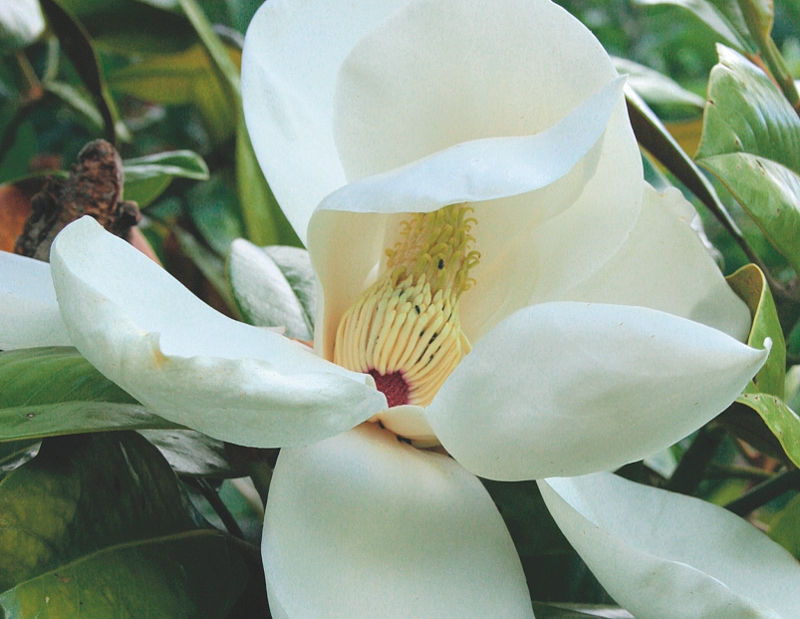
There is one plant which has, it appears, fully appreciated this year’s weather. That is the evergreen magnolia. These plants produce flowers which, when the shrub is mature, can reach 25cm across and unlike the other magnolias are very unlikely to suffer from frost damage because it flowers in August.
A final thought this month – it’s the time for ordering your bare root plants, not only are these cheaper than container grown ones but will also get a flying start ready for next year.
Robert Hudson, Lilyhurst Plant Centre