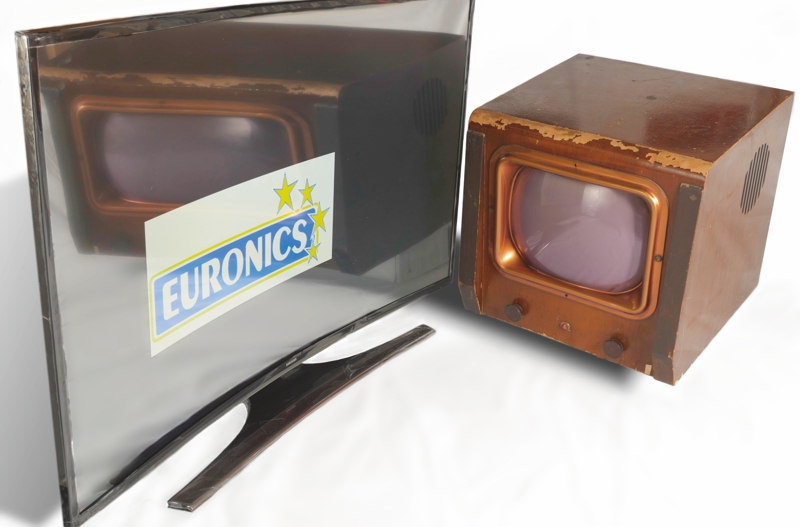
There will be many hundreds of hours of TV content consumed by most households this Christmas, not all of which will be watched on the box in the corner of the living room.
The TV set has come a long way since its inception back in the 1920s. Although we often attribute John Logie Baird as the inventor of the television, there wasn’t really a single inventor. Many pioneers around that time each came up with different aspects and showed different versions of TV. The phrase television was actually coined by Constantin Perskyi in 1900. Baird himself used part of a design patented by German student Paul Nipkow in 1884, a full 40 years before Baird. The Nipkow disk had a spiral pattern of holes that each scanned a line of the picture. It had a resolution of 18 lines.
Advances in electronic amplification in the early 1900s led to Baird publicly demonstrating the first greyscale television system using a mechanical disk for both scanning and displaying the image at 5 frames per second. A year later, in 1926, he added transmission over AM radio with an increased refresh rate. However, the American Charles Francis Jenkins, Soviet Léon Theremin and Kenjiro Takayanagi had all preceded Baird in some aspects.
The early television sets were mechanical and had a resolution of 30 lines initially, increasing up to 240 lines, determined by the number of holes on the Nipkow disk.
Ten years later saw the introduction of electronic TV when the 405 line monochrome analogue system was introduced. It was the first fully electronic system, competing against Baird’s 205 line mechanical system. Mechanical TV very quickly became obsolete, but 405 line continued to operate in the UK until 1985.
Although Baird was the first to show a colour set in 1928 it was not until the 50s that electronic colour sets were readily available. It took a further decade for most of the UK to catch up, by which time the BBC had introduced 625 line PAL TV which we still use as standard definition today. The trick with colour TV was to split the colour and brightness information and to transmit them at different resolutions.
The next revolution came in the 1990s when computing power made digital television a reality. The format was kept the same to fit in with existing TV sets. To become much more cinema like the shape of the picture changed to widescreen 16:9 ratios and CRT screens became flatter. At the turn of this century plasma and flat panel LCD TVs started to appear. Plasma TV had been described as far back as 1936. Another technological change was the short dabble in 3D, just 70 years after Baird first demonstrated it. Although the fad only lasted a couple of years the industry rumour is that it may well make a return.
For now consumers are looking towards increases in resolution by buying 4K sets. Japan is trialling 8K TV, but it is unlikely that it will be broadcast in Europe anytime soon. Manufacturers have realised that smoother pictures, better colours, deeper contrast and more immersive curved sets are all features that can make their TVs stand out from the crowd.
Even with these changes the vast majority of people will currently be watching standard definition programmes, upscaled to full HD and with motion smoothing. Broadcasters are moving away from interlaced formats and towards 4K and higher frame rates, but it takes time for them to catch up. Hence the spread of internet based services like Netflix which are filling the void, not just on streaming the programme but also on commissioning and producing them in the first place.
TV habits have changed from everyone gathering around a single set in the living room to watch the scheduled broadcast. Now you can watch video on demand on TV, computer, tablet and phone absolutely anywhere, anytime.
Tylers Gas & Electrical, Newport